
Introduction: Securing the Future with AI-Native Cloud Security
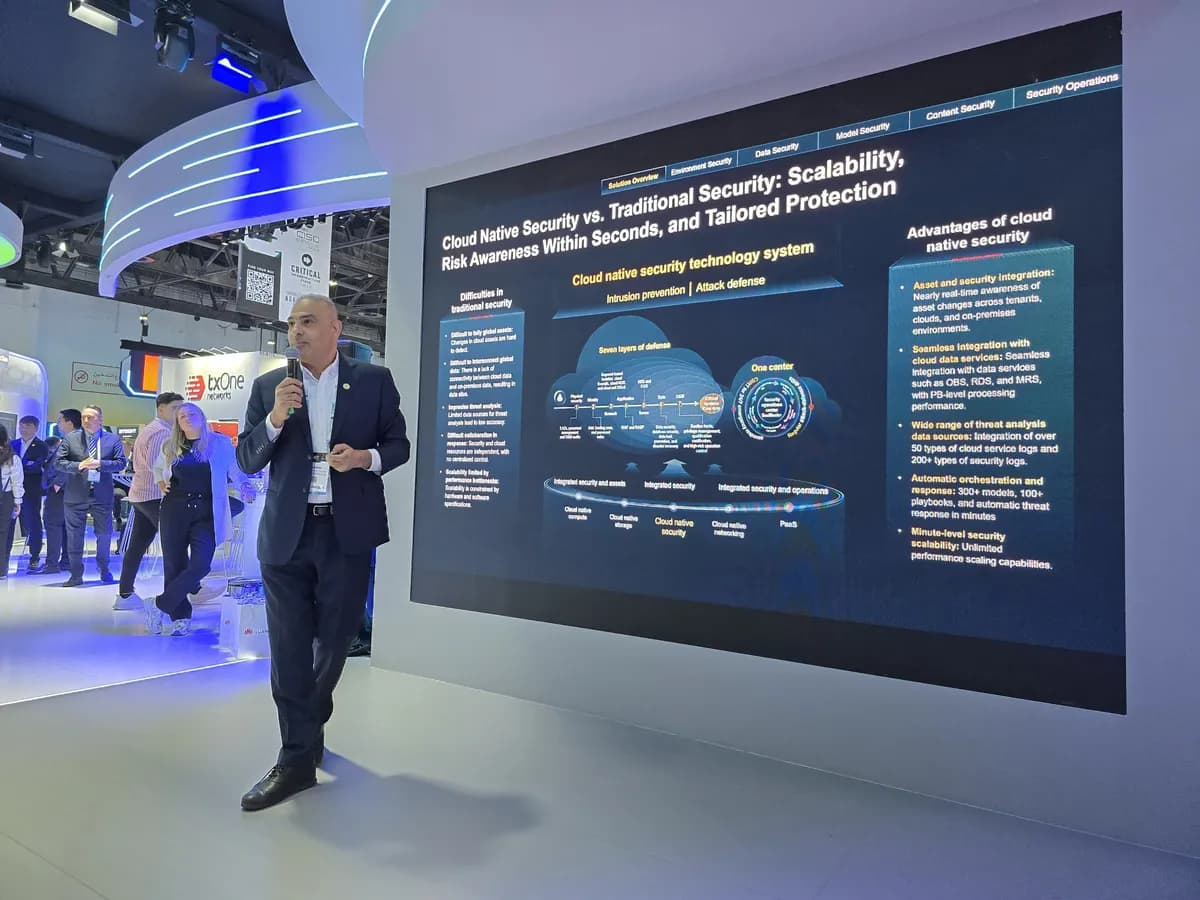
Cloud security is evolving, and at GISEC 2025, Huawei demonstrated its latest advancements in AI-native cloud security. Ashraf Khalil, Senior Solutions Architect of Cloud Security at Huawei Cloud Middle East & Central Asia, presented an in-depth look at Huawei’s seven-layer security framework. This approach provides end-to-end protection for cloud environments, specifically tailored for AI workloads.
Huawei’s Seven-Layer Security Model: A Deep Dive
During his presentation, Khalil introduced Huawei’s AI-native security solution built on a seven-layer defense strategy, including:
- Physical Security: Safeguarding data centers and physical assets.
- Identity Security: Verifying user identities and access control.
- Network Security: Protecting data through firewalls, anti-DDoS, and secure connections.
- Application Security: Ensuring secure app deployment and usage.
- Server Security: Enforcing encryption and protection for cloud servers.
- Operational Security: Monitoring through a centralized Security Operations Center (SOC).
- Management Security: Comprehensive governance and compliance management.
AI for Security and Security for AI: A Dual Approach
Huawei’s solution is built around two core concepts:
- AI for Security: Leveraging AI to enhance security capabilities, minimizing false positives and strengthening threat detection.
- Security for AI: Protecting AI workloads, data, and models, ensuring integrity and compliance.

Exclusive Interview: Ashraf Khalil on AI-Native Security
In an exclusive interview with Zamil Safwan, Khalil explained how Huawei’s AI-native cloud security differs from traditional models. He emphasized the importance of compliance, particularly in the Middle East and Central Asia, where data sovereignty is critical.
“We moved from cloud-native to AI-native security, integrating AI for security and security for AI,” Khalil explained. “Our solution offers a seven-layer security model, ensuring robust protection across all cloud assets.”
When asked about regional challenges, Khalil highlighted Huawei’s commitment to local compliance standards, citing their achievement of an A+ C certificate in Saudi Arabia. This commitment ensures that organizations in the region receive solutions that meet both international and local security standards.
Regional Relevance and Real-World Application
Huawei’s AI-native security model is particularly valuable for organizations in the Middle East and Central Asia. With compliance requirements varying across countries, Huawei’s localized approach ensures that data sovereignty and privacy are maintained.
Khalil also shared a real-world success story in the healthcare sector, where Huawei’s solution reduced security incidents by 50% while maintaining compliance and data integrity.
Looking Ahead: The Future of AI-Native Cloud Security
Khalil concluded the interview by discussing the future of AI-native security. Huawei is developing advanced AI models specifically designed to counter emerging threats like ransomware. With a vast R&D team, Huawei continues to innovate, ensuring organizations remain protected in an ever-evolving threat landscape.
Huawei’s AI-native cloud security represents a significant leap forward in protecting cloud environments, particularly for AI workloads. By integrating AI at every layer and ensuring compliance with local regulations, Huawei offers a robust, scalable, and secure solution for organizations across the Middle East and Central Asia.