
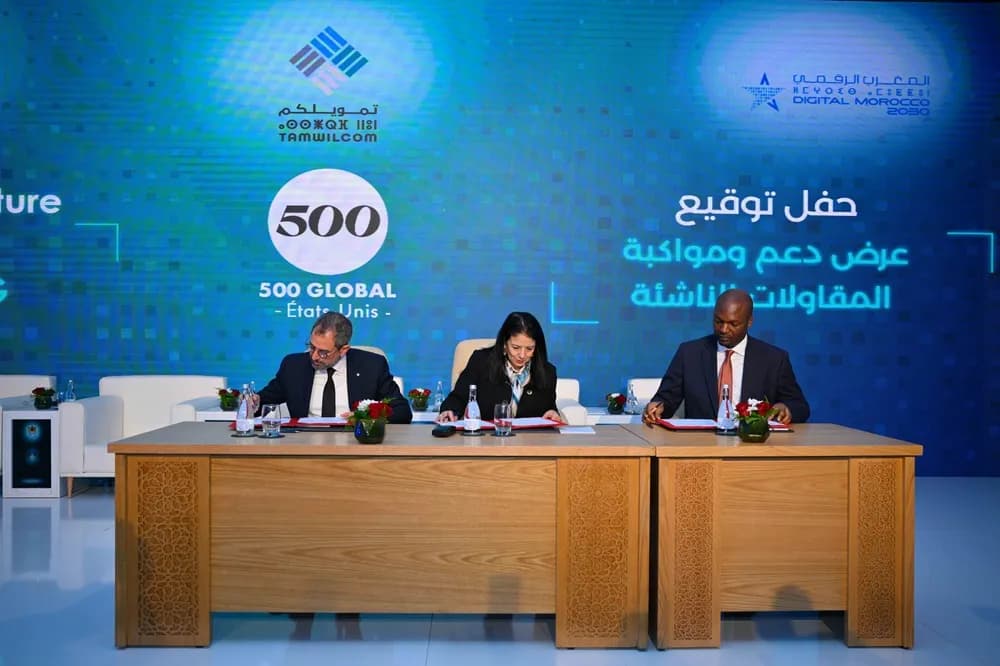
Casablanca — Venture capital firm 500 Global announced December 19 it has been selected to support Morocco’s Startup Venture Building initiative, a flagship program under the government’s Digital Morocco 2030 strategy. Here’s what the partnership means for founders, investors, and the broader Middle East-North Africa technology ecosystem.
What is the Digital Morocco 2030 program?
Digital Morocco 2030 is the Moroccan government’s national strategy to strengthen innovation and digital competitiveness through accelerating high-potential founders and providing training and financing pathways for startups to scale globally.
Launched by Morocco’s Ministry of Digital Transition and Administrative Reform and deployed by TAMWILCOM (the national guarantee fund), the Startup Venture Building (Startup VB) initiative aims to enable development of innovative technology solutions, mobilize founder-led financing, and advance the country’s digital transformation.
The program’s structure parallels similar government-backed venture initiatives across the MENA region, including Saudi Arabia’s venture capital programs under Vision 2030, Egypt’s ITIDA startup support mechanisms, and the UAE’s Hub71 ecosystem development model.
Why was 500 Global selected for this program?
While specific selection criteria have not been publicly disclosed, 500 Global’s track record in Africa and emerging markets appears to be a determining factor. The firm has invested in more than 100 African portfolio companies since its first continent investment in 2011, with these companies collectively raising approximately $1 billion in follow-on capital according to the firm’s internal estimates.
Notable 500 Global-backed African companies include Chipper Cash (cross-border payments), Smile Identity (digital identity verification), Stitch (financial infrastructure), Money Fellows (fintech), and Breadfast (quick commerce).
As implementation partner, 500 Global will provide founder support, network access, and early-stage capability development while working to strengthen Morocco’s national innovation systems. The firm states its role includes connecting Moroccan founders to growth networks across the Middle East, Africa, and Europe.
However, the partnership remains subject to negotiation and execution of definitive contractual agreements with relevant parties, according to a footnote in the company’s announcement.
How does this fit 500 Global’s broader Africa strategy?
The Morocco program represents a geographic expansion for 500 Global’s government collaboration model, which the firm has tested in other African markets with mixed approaches.
Existing Africa footprint:
- Egypt (since 2022): Partnership with Information Technology Industry Development Agency (ITIDA) supporting 150+ founders through Seed Bootcamp and Scale-Up initiatives
- Kenya (2025): Launch of founder programs in Nairobi as part of Sustainable Innovation Program
- Continental target: Activate startup accelerators in three African hub cities by end of 2026
Demola Adegbite, Partner at 500 Global leading African venture investments, emphasized ecosystem development requires coordinated public-private action: “Ecosystems accelerate fastest when public-sector leadership and private-sector expertise move in lockstep.”
What advantages does Morocco offer as an African tech hub?
Morocco’s geographic and economic positioning creates strategic advantages for venture-backed companies targeting multi-regional expansion.
Strategic positioning factors:
- Gateway location: Physical and economic bridge between Europe, Africa, and the Middle East
- Francophone-Anglophone crossover: Access to French-speaking African markets and English-language business ecosystems
- Stable regulatory environment: Relative political stability compared to other North African markets
- Established outsourcing sector: Existing tech talent base from IT services and call center industries
- Government commitment: Digital Morocco 2030 signals policy-level support for startup ecosystem development
Adegbite noted Morocco’s unique position: “Moroccan founders [can access] our global growth networks across the Middle East, Africa, and Europe, where we believe the country is uniquely positioned to serve as a bridge for global expansion.”
What does this mean for regional MENA venture capital flows?
The Morocco partnership reflects broader patterns in Middle East-North Africa venture capital ecosystem development, where government-backed programs increasingly partner with international VC firms to accelerate local startup maturity.
Regional context:
- Saudi Arabia, UAE, and Egypt have established government-linked venture programs with varying structures
- Cross-border investment within MENA region has grown as startups target multi-country expansion from inception
- International VC firms increasingly establish regional presences rather than investing remotely from US/Europe headquarters
Potential implications:
- Moroccan startups may gain faster access to follow-on funding through 500 Global’s LP network
- Regional startups in Saudi Arabia, Egypt, and UAE may view Morocco as viable expansion market if ecosystem strengthens
- Competitive pressure on other North African markets (Tunisia, Algeria) to enhance startup support infrastructure
What are 500 Global’s credentials in emerging markets?
500 Global manages $2.2 billion in assets under management (as of June 30, 2025, per internal estimates) and has backed over 5,000 founders across more than 3,000 companies operating in 80+ countries.
The firm claims it has invested in more than 35 companies valued above $1 billion and 160+ companies valued over $100 million, including private, public, and exited companies. These figures are based on internal estimates not independently verified.
Emerging markets experience:
- First Africa investment: 2011
- Portfolio companies across Southeast Asia, Latin America, Middle East, and Africa
- Government partnerships in Egypt, Kenya, and now Morocco
- Track record in pre-seed and seed-stage investments where local ecosystem infrastructure is nascent
What challenges might the Morocco program face?
While the announcement emphasizes opportunities, several structural challenges affect venture ecosystem development in emerging African markets:
Talent retention: Skilled technical founders often relocate to European or US markets where funding and exit opportunities remain more developed. Morocco will compete with France, Germany, and UK for founder retention.
Exit environment: Limited acquisition appetite from Moroccan or regional corporates means exits typically require attracting international buyers or pursuing growth toward later-stage funding rounds that remain scarce in the region.
Follow-on funding: After initial acceleration, startups require Series A and B capital that remains less available in Africa compared to mature markets. Success depends partly on 500 Global’s ability to mobilize its global LP network for follow-on investments.
Program sustainability: Government-backed programs risk disruption from political changes or budget pressures. Long-term ecosystem development requires multi-year commitment beyond initial program cycles.
Measurement methodology: 500 Global’s announcement relies heavily on “internal estimates not independently verified” – transparent impact measurement will be crucial for program evaluation.
What happens next for Moroccan founders?
While specific program details including application processes, timeline, and selection criteria have not been publicly announced, interested founders should monitor announcements from Morocco’s Ministry of Digital Transition and Administrative Reform and TAMWILCOM for program launch details.
Based on 500 Global’s existing programs in Egypt and Kenya, Moroccan founders can likely expect:
- Structured acceleration curriculum covering product-market fit, go-to-market strategy, and fundraising
- Mentorship access to 500 Global’s global network of operators and investors
- Demo day opportunities to present to regional and international investors
- Potential seed funding or investment facilitation
- Connection to 500 Global’s portfolio company network for peer learning and partnership opportunities
The program aims to provide “training and financing pathways needed to launch and scale globally” according to the announcement, suggesting emphasis on international expansion readiness rather than purely domestic market focus.


